Friday, July 23, 2010

The Dialectic of Presence and Absence


To illustrate the dialectic of presence and absence, he [Zizek] recounts the story of a guide conducting some visitors round an East European art gallery nad halting before a painting entitled 'Lenin in Warsaw'. There is no sign of Lenin in the picture; instead, it depicts Lenin's wife in bed with a handsome young member of the Central Committee. 'But where is Lenin?' inquire the bemused visitors, to which the guide gravely replies: 'Lenin is in Warsaw.' Terry Eagleton on Zizek (Figures of Dissent, p. 204)

Hotdog - Eagleton parodying Zizek (Figures of Dissent, p. 204)

The following captures something of his [Zizek] characteristic intellectual style: 'At first glance it would seem that the sausage in the hot dog wedges apart the two pieces of roll. But the roll itself is nothing but a "space" which the sausage creates around it, the phantasmal "frame" or support of the sausage without which it would vanish to nothing. On the other hand, the sausage itself can be seen as no more than an embodied gap between two pieces of bread, the mere pretext or occasion which prevents them from ever uniting.

Friday, June 11, 2010

Polemics ‘A Manifesto of Affirmationist Art’ – Alain Badiou, p.139

Lenin had already remarked that during times when critical and revolutionary political activity is very weak, what the sorry arrogance of imperialism produces is a mixture of mysticism and pornography. That’s exactly what we are getting today in the form of formal romantic vitalism. We have universal sex, and we have oriental wisdom. A Tibetan pornography: that would fulfill the wish of this century, which is putting off inventing its birth.

Wednesday, May 26, 2010

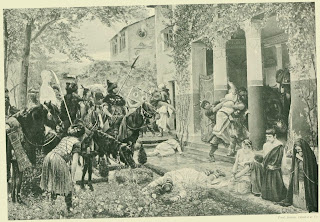
Robert Desnos, “Description d’une révolte prochaine" (image by Georges Rochegrasse)


Having coming from the shadowy East, the men who had been civilized continued the same westward march as Attila, Tamburlaine and so many other famous men. Any man who can be described as “civilized” was once a barbarian. They were, in other words, the bastard sons of the adventurers of the night, or those the enemy (the Romans, the Greeks) had corrupted. Driven away from the shores of the Pacific and the slopes of the Himalayas, and unfaithful to their mission, they now found themselves facing those who drove them out in the not so distant times of invasions. Sons of Kalmouk, grandsons of the Huns, if you just stripped off the robes borrowed from a wardrobe in Athens or Thebes, the breastplates collected in Sparta and Rome, you would look as your fathers looked on their little horses. And you Normans who work the land, who fish for sardines and who drink cider, just get back on those flimsy boats that traced a long wake beyond the Arctic Circle before they reached those damp fields and these woods that teem with game. Mob, recognize your master! You thought you could flee it, flee that Orient that drove you away by vesting you with the right to destroy what you could not preserve, and now that you traveled around the world, you find it snapping at you heels again. I beg you, do not imitate a dog trying to catch its own tail: you will be running after the West forever. Stop. Say something to explain your mission to us, great oriental army, you who have now become The Westerners.

Robert Desnos, “Description d’une révolte prochaine,” La Révolution surréaliste, no.3. April 1925, p.25; reprinted in La Révolution surréaliste(1924-1929) (Paris, 1975 [facsimile edition])

Society Must Be Defended pp. 198-9 Michel Foucault

Tuesday, May 25, 2010

Language, Counter-Memory, Practice “Language to Infinity” – Michel Foucault, p.55

Perhaps there exists in speech an essential affinity between death, endless striving, and the self-representation of language. Perhaps the figure of a mirror to infinity erected against the black wall of death is fundamental for any language from the moment it determines to leave a trace of its passage. Not only since the invention of writing has language pretended to pursue itself to infinity; but neither is it because of its fear of death that is decided one day to assume a body in the form of visible and permanent signs. Rather, somewhat before the invention of writing, a change had occur to open the space in which writing could flow and establish itself, a change symbolized for us in its most original form by Homer, that forms one of the most decisive ontological events of language: mirrored reflection upon death and construction, from this reflection, of a virtual space where speech discovers the endless resourcefulness of its own image and where, it can represent itself as already existing behind itself, already active beyond itself, to infinity. The possibility of a work of language find its original fold in this duplication.

Language, Counter-Memory, Practice “Language to Infinity” – Michel Foucault, p.55

Language, Counter-Memory, Practice “Preface to Transgression” – Michel Foucault, pp. 44-


“When at the height of anguish, I gently solicit a strange absurdity, an eye opens at the summit, in the middle of my skull.” – Georges Bataille, Inner Experience

This is because the eye, a small white globe that encloses it darkness, traces a limiting circle that only sight can cross. And the darkness within, the somber core of the eye, pours out into the world like a fountain which sees, that is, which lights up the world; but the eye also gathers up all the light of the world in the iris, that small black spot, where it is transformed into the bright night of image. The eye is mirror and lamp: it discharges its light into the world around it, while in a movement that is not necessarily contradictory, it precipitates this same light into the transparency of its well. Its globe has the expansive quality of a marvelous seed – like an egg imploding towards the center of night and extreme light, which it is and which it has just creased to be. It is the figure of being in the act of transgressing its own limit.

The eye, in a philosophy of reflection, derives from its capacity to observe the power of becoming always more interior to itself. Lying behind each eye that sees, there exists a more tenuous one, an eye so discreet and yet so agile that that its all-powerful glance can be said to eat away at the flesh of the white globe; behind this particular eye, there exists another and, then, still others, each progressively more subtle until we arrive at an eye whose entire substance is nothing but the transparency of vision. This inner movement is finally resolved in a nonmaterial center where the intangible forms of truth are created and combined, in this heart of things which is the sovereign subject. Bataille reverses this entire direction: sight, crossing the globular limit of the eye, constitutes the eye in its instantaneous being; sight carries it away in this luminous stream (an outpouring fountain, streaming tears and, shortly blood), hurls the eye outside of itself, conducts it to the limit where it bursts out in the immediately extinguished flash of its being. Only a small white ball, veined with blood, is left behind, only exorbitated eye to which all sight is now denied.

Language, Counter-Memory, Practice “Preface to Transgression” – Michel Foucault, pp. 44-45

Friday, May 21, 2010

Tangency

Silent siren
and muted flash,

Wind was pompous
and made the leaves
louder
than his breath.

when he was proud of his strength, every December
Drunk like a man,
Drunk like a car,
Both would overturn everything that gets in the way
and itself.

Clarity,
than the affair
between another curve and line:
the window grille
reflected on the dusty grey TV screen.

What’s the simple word to be written?
on another even layer of dust

We weren’t barefooted,
I didn’t grasp the notion of sand –
We were surely not 6.21pm at the beach.

We would love to prostitute our imagination
Let the red light in

for memory or sensation
of sand between our toes
without soul.